

China, Russia, India seek economic cooperation at BRICS
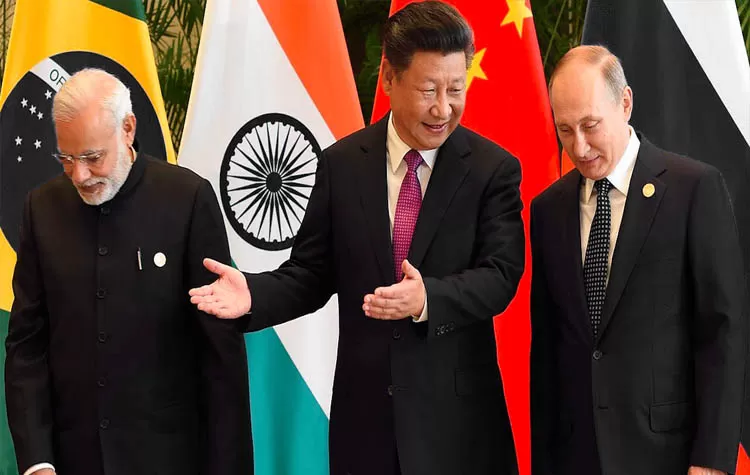
BRICS Leaders Focus on Economic Cooperation
Leaders of the BRICS group have placed economic cooperation at the centre of discussions in New Delhi as the expanded organisation seeks to turn its growing membership into greater practical cooperation.
China, Russia and India are among the bloc's most influential economies, and their positions are important to efforts aimed at expanding trade, improving investment flows and developing new channels for economic engagement.
The discussions come as BRICS attempts to build a broader economic partnership while individual members continue to manage different national priorities and relationships with countries outside the group.
India Uses Its 2026 BRICS Chairship to Push Trade
India's 2026 BRICS chairship has placed strong emphasis on resilience, innovation, cooperation and sustainability.
Indian officials have worked throughout the year to advance the BRICS Economic Partnership 2030, while also focusing on trade in services, global value chains, small businesses and digital commerce.
Earlier BRICS trade meetings under India's chairship also produced proposals designed to improve access to finance for export-oriented small and medium-sized businesses.
- The 18th BRICS Summit was held in New Delhi on September 12–13, 2026.
- India held the BRICS chairship during 2026.
- China, Russia and India are among the bloc's key founding members.
- BRICS members are working toward the BRICS Economic Partnership 2030.
- Trade, investment, financial connectivity and technology are major areas of cooperation.
- BRICS is also exploring stronger cross-border payment mechanisms and greater use of local currencies.
- The expanded grouping includes major emerging economies from Asia, Africa, the Middle East and Latin America.
China Pushes a Bigger Economic Role for BRICS
Chinese President Xi Jinping has called for a stronger economic role for what he described as a broader or "Greater BRICS" grouping.
China has proposed initiatives covering artificial intelligence, services trade and economic partnerships. Beijing has also backed efforts to create a more stable and integrated market among participating countries.
One of the proposals involves a BRICS AI Open Source Zone, while China also plans to host a Service Trade Forum in 2027.
Russia Wants BRICS to Become More Practical
Russia has also argued that BRICS should concentrate on practical economic cooperation rather than remaining primarily a political discussion forum.
Russian President Vladimir Putin has highlighted areas such as technology, infrastructure, investment and payment systems as potential fields for deeper cooperation.
During his meeting with Indian Prime Minister Narendra Modi on the sidelines of the summit, the two sides reviewed cooperation in trade, energy, infrastructure, defence, space and other sectors.

India and China Look to Improve Business Ties
The BRICS summit also provided an opportunity for India and China to discuss the possibility of improving economic relations after years of political and security tensions.
Prime Minister Narendra Modi and President Xi Jinping held bilateral discussions in New Delhi, with both sides highlighting the importance of maintaining peace and improving economic and people-to-people links.
Trade between the two countries remains substantial, although India continues to face a large trade imbalance with China. Both governments have an interest in making economic ties more stable while managing their broader strategic differences.
Local Currencies and Cross-Border Payments
Another important element of BRICS economic cooperation is the search for more efficient cross-border payment arrangements.
The group's payment task force has been examining ways to improve interoperability between payment and messaging systems.
BRICS members have also discussed the use of local currencies for trade settlements and investment. The approach does not mean that every member has adopted a single common currency; instead, the focus is on creating more options for cross-border transactions.
Trade and Global Supply Chains
Supply-chain resilience is another priority for the expanded grouping.
BRICS members are looking at ways to strengthen global value chains and increase cooperation in areas including manufacturing, agriculture, pharmaceuticals, energy and technology.
A more diversified network of suppliers and markets could help participating economies respond to disruptions caused by geopolitical tensions, transport problems, natural disasters or sudden changes in global demand.
Technology Becomes a Major BRICS Priority
Technology is becoming increasingly important to the bloc's economic agenda.
Artificial intelligence, digital services, innovation and emerging technologies are now being discussed alongside traditional areas such as energy and manufacturing.
China's proposal for a BRICS AI Open Source Zone is one example of how members are attempting to create practical cooperation around new technologies.
India has also promoted cooperation in startups, digital services and innovation during its 2026 chairship.
Small Businesses Get Greater Attention
BRICS economic discussions are not limited to major corporations and governments. Small and medium-sized enterprises are also receiving increased attention.
India's BRICS trade agenda included proposals to improve credit access for export-oriented MSMEs and reduce some of the financing difficulties faced by smaller businesses.
Supporters of these initiatives argue that stronger small-business participation could help turn BRICS trade agreements into wider economic opportunities for workers and entrepreneurs.
Energy and Infrastructure Remain Important
Energy continues to be one of the most important areas of economic cooperation between BRICS countries.
Russia and China are major energy producers and exporters, while India is one of the world's largest and fastest-growing energy markets.
Infrastructure investment is another potential area of cooperation, particularly as developing economies seek better transport networks, digital connectivity, energy systems and industrial capacity.

BRICS Is Larger Than It Was a Decade Ago
The BRICS grouping has expanded significantly from its original five-member structure.
Brazil, Russia, India, China and South Africa formed the core group, while Egypt, Ethiopia, Iran, the United Arab Emirates and Indonesia have since joined the expanded grouping.
The larger membership gives BRICS greater geographic reach and economic weight, but it also means that members must find common ground despite differences in their foreign policies, economies and strategic interests.
Why Economic Cooperation Is Important
The combined economic weight of BRICS gives the organisation a potentially significant role in global trade and investment.
Supporters argue that closer cooperation could give developing economies greater influence over international economic institutions and create additional channels for trade and finance.
The challenge will be converting broad political commitments into projects that businesses, investors and ordinary citizens can actually use.
BRICS Faces Challenges Too
Despite the push for closer cooperation, BRICS is not a single economic bloc with identical interests.
Member countries have different currencies, financial systems, industrial policies and foreign-policy priorities. Some members also have unresolved political disputes with one another.
That means the group's economic agenda is likely to develop gradually, with individual countries choosing areas where cooperation is practical and mutually beneficial.
Watch: BRICS Summit 2026 Coverage
What the New BRICS Economic Agenda Could Mean
If the initiatives discussed by BRICS members are implemented effectively, businesses could gain more opportunities to enter new markets across the expanded grouping.
Improved payment systems could simplify some cross-border transactions, while cooperation in technology and supply chains could help members develop new industries and reduce vulnerabilities.
However, the success of the agenda will depend on how quickly governments can translate summit declarations into agreements, investment and functioning institutions.
China, Russia and India: A Key Economic Triangle
China, Russia and India occupy particularly important positions within BRICS because of their size, resources, markets and strategic influence.
China brings enormous manufacturing capacity and technological strength. Russia remains a major energy and commodities supplier, while India provides a huge consumer market, a rapidly expanding services sector and a growing technology industry.
Closer economic cooperation between the three could therefore have consequences well beyond BRICS itself.
BRICS Economic Cooperation: The Bottom Line
The 2026 BRICS summit in New Delhi has placed economic cooperation firmly at the centre of the group's future agenda.
China is pushing new initiatives in AI, services and economic integration, Russia is advocating stronger cooperation in infrastructure, technology, payments and investment, while India is using its chairship to advance trade, MSME financing, global value chains and digital services.
The expanded BRICS grouping now has greater economic reach than its original five-member structure, but its long-term influence will depend on whether its members can turn ambitious declarations into practical cooperation.
BRICS 2026 Official Information:
India hosted the 18th BRICS Summit in New Delhi on September 12–13, 2026.
Official BRICS 2026 website
BRICS Economic Partnership:
India's Ministry of Commerce and Industry reported progress toward the BRICS Economic Partnership 2030, stronger trade in services, global value chains and improved financing for MSMEs.
Government of India — BRICS Trade Ministers
BRICS Industrial Cooperation:
BRICS industry ministers have also advanced cooperation covering MSMEs, photovoltaics, startups and logistics.
Government of India — BRICS Industry Ministers
China's Economic Proposals:
Reporting from the 2026 summit covered China's proposals involving AI, trade, finance and wider BRICS economic integration.
Reuters report
Video:
ET Now — BRICS Summit 2026 coverage from New Delhi.
This article has been independently written in original wording and is not a reproduction of any source article.

